
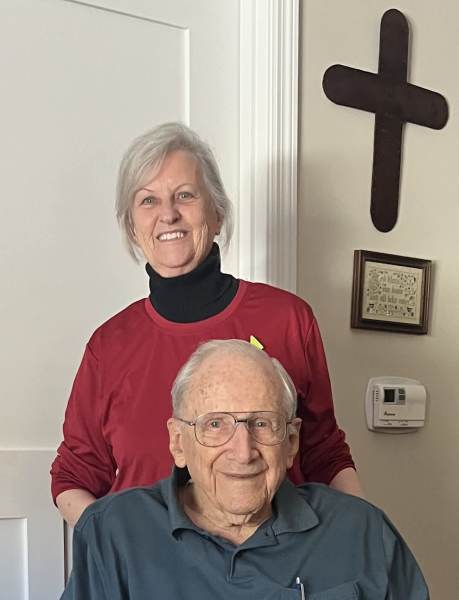
Jim and Gemma Hickman will celebrate 19 years of marriage in January 2026. Both would actually be called Jimmie Hickman, but for the wise choice to call Mrs. Jimmie Hickman by a different name - landing on the endearing “Gemma” (pronounced “Jim’-uh”).
Both came into this marriage having already known love. Gemma is originally from Arkansas and moved to the Birmingham area in the year 2000, not long after her husband passed away. Jim’s life had taken him from his roots in Missouri across much of the country by the time he settled in Alabama in 2004 following the death of his wife.
The two met at First Baptist Church of Trussville, where friends in the church’s Senior Adult Ministries group encouraged them to date—encouragement that eventually turned into marriage. Together, they settled into a comfortable life in the Birmingham area until severe pain in one of Jim’s legs led to amputation, and it became clear that living with care nearby would be essential.
The couple moved in to Fair Haven the day before their 18th wedding anniversary in January of 2025, and a new chapter in life began.
A Life Fully Lived
Jim Hickman is the author of two books and the owner of more stories than can possibly be told in a single afternoon—though he might try. Long before becoming a Fair Haven resident, Jim was already familiar with the community. After moving to Alabama, he frequently visited Fair Haven as a guest speaker, sharing stories from his interesting career, wide travels, and unique life experiences.
Recently, Jim resumed that storytelling role and shared something especially meaningful with fellow residents: a documentary film from the 1950s in which he himself appears. The three-part documentary, “Labor of Love”, was produced by the United States Information Agency (USIA) and filmed early in Jim’s career with the Forest Service. Now available on YouTube, the film traveled around the world—dubbed into multiple languages. The USIA functioned as a diplomatic agency spreading messages about US policy, culture and values from 1953 until it was absorbed by the State Department in 1999.
In addition to Jim, the film also featured two other public servants - a social worker and physical therapist. Jim explained, “They said they were sending these to third-world countries to show that in the US when you got a degree it didn’t mean you quit working.”
But the documentary is only a tiny chapter in a life defined by curiosity, courage, and movement. After Jim and Gemma were married, Jim made a point of taking Gemma to many of the places he had lived throughout his life.
Gemma finds his life endlessly fascinating.
“One thing I want to add that has always fascinated me about Jim in that there was a lot of intrigue before we got married and since, but his life is so full of adventure, and wanting to know what’s around the next corner. A curiosity and a love for life that when, I mean, so many times he went right by himself hitchhiked most of the time to go to see different places.”
She continued, “It always fascinated me that as such a young age he was doing these things all by himself. His whole family are adventurers.”
Jim’s travels were fueled by grit, determination, and a willingness to step into the unknown.
Shaped by History, Family and Hard Work
Jim’s life has been shaped profoundly by where—and how—he grew up, as well as the variety of people he has been privileged to share life’s moments with. He was born in the Ozarks of Missouri, where, as he put it, “My family were hill people. In the Ozarks, where Lake of the Ozarks is now.”
Gemma shared an important part of Jim’s early story. “His father left when he was about 2 years old. He was raised by his mother and his grandparents. His grandfather was a minister and his grandmother and mother were teachers… so he has good influence from his mom and grandparents.”
Jim agreed simply, “That made a huge difference.”
During the Great Depression, Jim’s family moved constantly following contracts for preaching or teaching jobs, wherever they led. The family made about $1 a day, but it was work. He remembers his mother later telling him about standing near train tracks in the 1930s, watching flatcars filled with men who weren’t so lucky, traveling west in search of jobs.
“She said that she pointed out to me that they were wrapped in newspaper because that was warm. They didn’t have coats. Newspaper was about the warmest thing you could find.”
From an early age, Jim also worked. During World War II, he worked in the wheat crops and vegetable crops along with other students from the high school who wanted to work. His stepfather was a logger and Jim spent time working with him in the woods, learning a trade that in later years would serve him well.
His stepfather had not gone to college, but Jim said there was never any question that he was college-bound.
“That was really not a matter of discussion. That was circumspect. I was going to college, so I did,” Jim said.
After attending a two-year college first, he transferred to Oklahoma Baptist University. One summer break, Jim worked in a steel mill on the labor gang around one of the open-hearth furnaces that supplied the Korean War. Jim was one of the few English-speaking workers, as most of the workforce were displaced Europeans.
His last year in college, he went to work at an airport just a short walk from the university. “I wanted to fly,” Jim mused. “Always wanted to fly. I got a couple of rides with ex-World War II pilots that were at university. I went to work for a fixed-base operator so when I wasn’t in school or studying, I was working at the airport. I was carrying mail and running the teletype, things like that.”
Additionally, Jim had a friend at the university who had been a ‘smoke jumper’ – a parachuting firefighter – in Montana. Jim said, “He told me about that and I thought, well I’d like to do that.” Jim graduated from OBU with a physical chemistry degree and immediately got on a bus to Montana to begin training to be a smoke jumper. His previous experience in the woods landed him acceptance into the field of elite firefighters.
However, duty to his country called not long after he began the training. He spent the next 3 ½ years in the US Navy.
“I was in underwater demolition. I wanted to fly, but instead I swam and blew things up. This was ten years before the seals were commissioned, and we were called frogmen.”
After the Navy, Jim went back to school, this time at Utah State University on the GI Bill, got a private pilot’s license, and also learned to ski. He eventually re-joined the smoke jumpers and spent a year jumping fires, It was there that he was introduced to the Forest Service. Jim rotated dispatch and aerial fire reconnaissance for the Forest Service, and after graduation, joined them full time. Thus began a satisfying and adventurous 35-year career, from forester to District Director of various regions, and eventually finishing his career as the Director of Aviation Fire Management for the region that included Arizona, New Mexico, part of California, and part of Colorado. In semi-retirement, he spent five more years as a driver and supervisor for a special operations group in emergency response out of Cody, Wyoming, which expertly bussed emergency response teams into the mountains to fight fires.
Stories Written and Lived
Jim’s love of history and gift for storytelling eventually made its way onto the printed page. He is the author of the historical novel Mule Shoes to Santa Fe, a meticulously researched story that led Jim to personally hike the Cumberland Gap to ensure he could write about the experience with confidence.
“I wanted to make sure I knew what I was writing about.”
Jim also used the name ‘Greenup’ as a character in the book, a real historical name that followed his family for generations. “My great, great, great… grandfather was governor of Kentucky in 1804. His name was Christopher Greenup,” Jim said. “We kept that name through my maternal grandmother. We were Greenup through all those years.”
Jim continued, “Later on, toward the end of the book, I talk about St. Genevieve’s ferry on the Mississippi River, and I had already written that. Then I thought, oh my goodness, maybe I messed up, maybe there wasn’t a ferry in 1840.” The potential damage was already done, but he decided to go and find out for himself.
Since Jim and Gemma already had plans to visit family in Missouri, they took a detour into St. Genevieve’s and went straight to the Mississippi River there and found a ferry. “The ferry there is still operating, which was started in 1829.” Jim explained his relief, “My book was 1840, so I was safe.”
He also authored a collection of short stories called You Smell Like a Grandpa, and Other Campfire Stories, inspired by moments from Jim’s life. The story that gives the book its title is especially meaningful for both Jim and Gemma.
While Gemma was working in the library at First Baptist Church of Trussville, Jim would often bring sandwiches so they could eat together on the playground. One day, a little girl climbed into Jim’s lap, wrapped her arms around his neck, and declared, “You smell just like a grandpa!”
Gemma recalled, “Jim and I both just lost it, tears streaming down your face. But that’s one of the happiest memories.”
Home at Fair Haven
Today, life is quieter—but no less full.
“Our needs are met,” Jim said. “And I don’t have to worry about trying to get ready to go outside in the weather. That’s probably the best thing—there aren’t many concerns.”
At Fair Haven, Jim leads a weekly Bible study and sings in the Fair Haven Chorus.. Together, Jim and Gemma enjoy movie nights, ice cream socials, lunch outings, jigsaw puzzles, and regular entertainment from churches and community groups throughout Birmingham.
Faith remains central to their lives. They often watch the livestreamed service from First Baptist Church of Trussville—where their son Ross frequently participates in worship—before attending services at Good Shepherd Chapel at Fair Haven. They enthusiastically encourage others to join them.
Gemma summed it up best.
“It became home almost immediately. I mean both of us are comfortable here and it’s only when you go out that door that you realize you’re in a community. It’s a very loving, kind community.”
After a lifetime of movement, service, and adventure, Jim and Gemma Hickman have found something else meaningful: a place to belong.
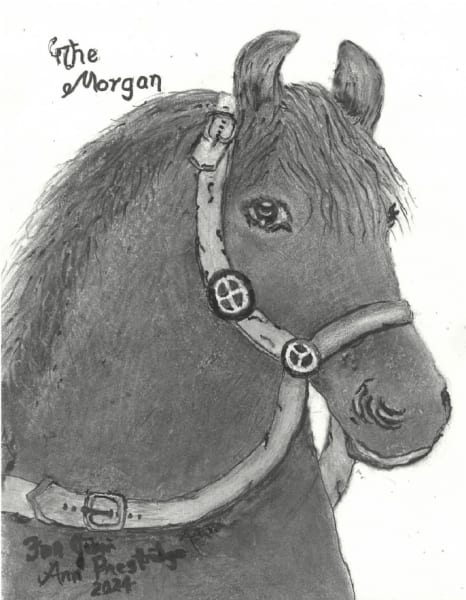
This drawing of a Morgan horse was inspired by Jim Hickman's book, Mule Shoes to Santa Fe.
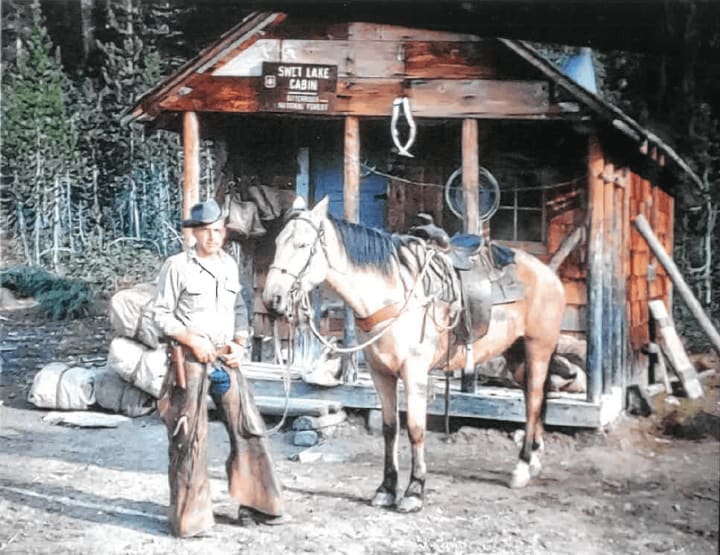
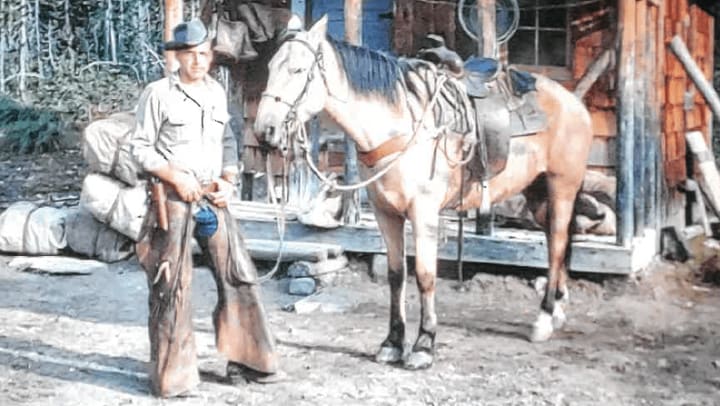
A young Jim Hickman with his horse in the Magruder Corridor of Bitterroot National Forest.
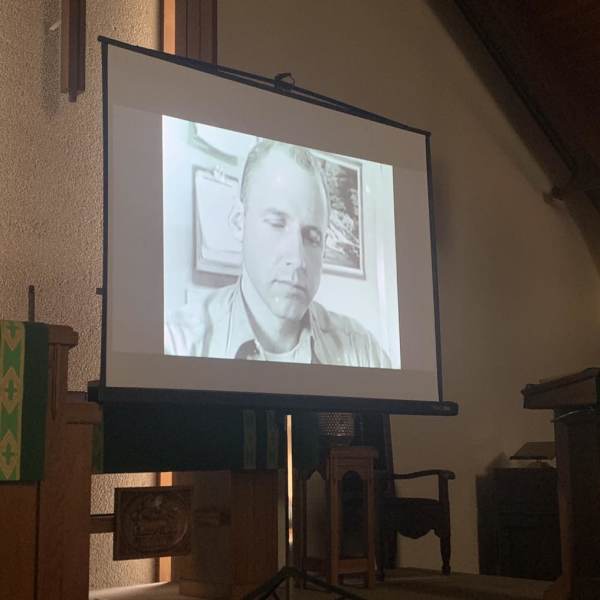
Jim Hickman appeared in the 1950s documentary film "Labor of Love" by the USIA, which he recently shared with fellow residents.